Magento began life as a popular open-source ecommerce platform, later offering a paid “Enterprise/Commerce” edition alongside Magento Open Source. In 2018, Adobe acquired Magento to fold commerce into the Adobe Experience Cloud.
The deal was announced in May 2018 and completed in June for roughly $1.68B, positioning Magento to power Adobe’s experience-driven commerce strategy.
What’s changed since Adobe took over
Branding and product direction
In 2021, Magento Commerce was rebranded as Adobe Commerce, signalling tighter alignment with Adobe’s enterprise Experience Cloud and a shift toward cloud-native, composable services (e.g., Live Search, App Builder, Edge Delivery).
Enterprise positioning
Adobe now presents Commerce as an enterprise-scale platform (B2C and B2B), with cloud delivery, auto-scaling and deep integrations across the Adobe stack, great for larger brands with complex needs and budgets.
Marketplace and licensing models
Post-acquisition, Adobe enabled subscription licensing for extensions on the official marketplace, reflecting a broader move toward recurring models.
Upgrade and lifecycle realities
Magento 1 reached end-of-life in June 2020, which pushed many merchants to migrate or assume additional security responsibility. That milestone underscored the cost/complexity of major version changes in the Magento ecosystem.
Magento Open Source, Hyvä, and the community ecosystem
Alongside Adobe Commerce, Magento Open Source continues to be actively used and supported by a large global developer community. In recent years, much of the innovation in the ecosystem has come from the community itself, particularly around frontend performance.
One of the most notable examples is Hyvä, a modern frontend framework designed to replace Magento’s default theme layer. Hyvä removes much of the legacy frontend complexity and enables faster, cleaner storefronts using modern tooling.
However, it’s important to understand what this does, and does not, change.
Hyvä improves frontend performance and developer experience, but it still sits on top of Magento’s underlying architecture. The backend complexity, upgrade considerations, extension dependencies, and infrastructure requirements remain. As a result, delivering and maintaining a well-optimised Magento + Hyvä store typically requires Magento-savvy agencies and developers who understand the platform deeply.
For teams with the right expertise, Magento Open Source paired with Hyvä can be a powerful setup. But it is still a specialist stack, not a lightweight one.
A lighter alternative: Aero Commerce
If you need high-performance storefronts without enterprise-level infrastructure complexity, Aero is a modern alternative: clean architecture, fast storefronts on affordable hosting, agency-friendly workflows, and far fewer moving parts to maintain.
Magento (Adobe Commerce and Open Source) vs. Aero: A practical comparison
This comparison reflects both Adobe Commerce and Magento Open Source setups, including modern frontends such as Hyvä, and focuses on the day-to-day realities agencies and retailers face in production.
Complexity and day-to-day management
Magento / Adobe Commerce
Adobe Commerce is powerful, but its codebase is heavy. Day-to-day changes often require specialist Magento developers, custom modules, and careful dependency management, particularly once a store is highly customised.
This remains true for both Adobe Commerce and Magento Open Source builds, particularly as customisation increases.
Aero Commerce
Aero is designed to stay lean. Agencies can build bespoke stores without fighting the core platform, and retailers can manage day-to-day changes without constant developer intervention.
Total cost of ownership
Magento / Adobe Commerce
Costs add up quickly. Beyond licensing (for Adobe Commerce), retailers must factor in enterprise-grade hosting, ongoing development, upgrades, and long-term maintenance.
Aero Commerce
Aero focuses on predictable costs. Hosting requirements are lighter, essential functionality is included out of the box, and there’s no need to budget for frequent rebuild-style upgrades.
Performance and hosting
Magento / Adobe Commerce
Strong performance is achievable, but usually requires layered caching and complex infrastructure (Varnish, Redis, Elasticsearch), which increases cost and operational overhead.
Even with modern frontends like Hyvä, strong performance is typically engineered through infrastructure and caching strategies rather than being inherent to the platform.
Aero Commerce
Aero delivers consistently fast storefronts on affordable infrastructure, without relying on complex stacks to achieve acceptable performance.
Upgrades and long-term stability
Magento / Adobe Commerce
Magento 1’s end-of-life highlighted the risks of major version changes. Even today, upgrades can be time-consuming and disruptive for heavily customised stores.
Aero Commerce
Aero is built to evolve without breaking changes. Updates are incremental, reducing risk and avoiding the need for full rebuilds.
Extensions and ecosystem
Magento / Adobe Commerce
The extension ecosystem is vast, but quality varies. Plugin conflicts and maintenance issues are common in complex builds.
Aero Commerce
Aero requires fewer extensions overall. Where integrations are needed, they’re curated and maintained with performance and stability in mind.
Magento vs. Aero: Quick snapshot
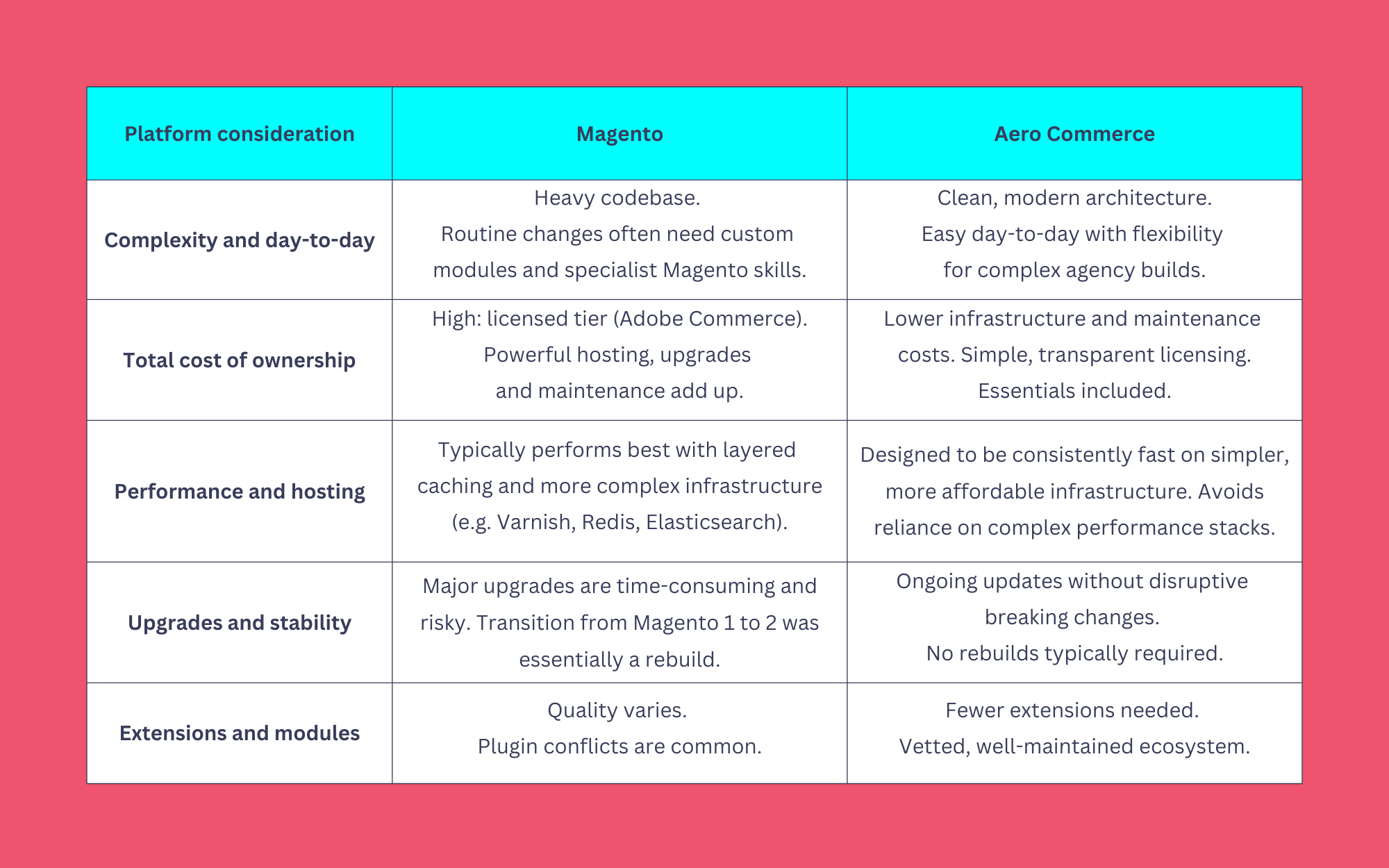
When comparing Magento (both Adobe Commerce and Open Source) with Aero, the differences tend to show up less in feature lists and more in day-to-day reality.
Magento is a powerful and flexible platform, but that power comes with complexity. Performance, stability, and scalability are achievable, but typically require specialist Magento developers, layered infrastructure, and ongoing maintenance as stores evolve.
Aero takes a different approach. The platform is designed to stay lean at its core, delivering strong performance and essential ecommerce functionality without requiring complex stacks or rebuild-heavy upgrades. Agencies can still build highly bespoke experiences, but without constantly fighting the platform beneath them.
In short, Magento rewards deep platform expertise. Aero prioritises speed, simplicity, and predictable long-term ownership.
 Should retailers still choose Magento?
Magento, particularly Adobe Commerce, remains a strong choice for certain types of businesses.
If you’re a large enterprise already invested in Adobe Experience Cloud, with in-house or agency teams experienced in Magento, the platform can deliver deeply integrated, highly customised commerce experiences.
Magento Open Source also continues to power many successful stores, especially when paired with modern frontend approaches like Hyvä. For teams with the right technical skillset, this can be a powerful combination, but it remains a specialist stack that requires careful optimisation and long-term maintenance planning.
For many growing and mid-sized retailers, however, the balance has shifted. Rising infrastructure costs, specialist development requirements, and the operational overhead of managing complex builds have made lighter, performance-first platforms more attractive.
That’s where Aero fits.
Aero is designed for retailers who want enterprise-grade performance without enterprise overhead, offering speed, stability, and flexibility without locking teams into heavyweight infrastructure or constant firefighting.
Which platform is right for you?
Choosing an ecommerce platform isn’t about “best vs worst”. It’s about fit. Magento and Aero serve different needs, and the right choice depends on your scale, technical appetite, and long-term goals.
Magento may be right if you:
Want a fully open-source platform with maximum flexibility and control
Have access to Magento-savvy developers or specialist agencies
Are comfortable working within a developer-led ecosystem, including tools like Hyvä for front-end performance
Expect to invest ongoing time and budget into optimisation, infrastructure, and maintenance
Need highly bespoke functionality and are prepared for the complexity that comes with it
Aero Commerce may be right if you:
Want high performance and flexibility without the operational weight of a large open-source stack
Prefer a platform that delivers essential ecommerce functionality out of the box, rather than assembling it piece by piece
Value predictable costs, simpler hosting, and fewer moving parts to maintain
Need a platform agencies can move quickly with — building, iterating, and scaling without constant firefighting
Want modern architecture that stays lean as your business grows
Aero is designed for retailers and agencies who want the benefits of modern ecommerce, such as speed, stability, and scalability, without needing a specialist Magento team to keep things running smoothly.
Looking for a faster, lighter alternative to Magento?
If you’re weighing up Magento’s flexibility against long-term complexity, seeing a lean alternative in action can make the decision clearer.
Book a demo with the Aero team to see how high-performance ecommerce can work without enterprise overhead.